Over the years, I have had opportunity to work in different roles at JADE Community, a Finnish organisation working with older migrants. My responsibilities have included throughout the year for example peer group activities, service guidance and cooperation with researchers and educational institutions. This year I have been responsible for developing our outreach work and I must say it has been interesting. Perhaps because it has made me look at many familiar questions from a slightly different perspective.
When working with the peer groups, we often think about how people find one another, what makes them feel welcome and how a sense of belonging develops. In service guidance, we see how complicated even ordinary everyday matters can become when someone is unfamiliar with the service system or faces several difficulties at once. Outreach work brings another question to us, how do we find the people who are not finding us? At first, this seems like a fairly straightforward question, after all the purpose of outreach work is to reach people who are not being reached through existing activities or services. But the more we have experimented with different approaches, the more I have begun to question what we actually mean when we describe someone is hard to reach.
Is a person hard to reach because they do not know we exist or because they can’t access what we offer? What if they do not recognise their own need for support or have become so accustomed to managing alone that they no longer imagine things could be different? Also how much of being hard to reach is really about the individual, rather than the ways in which we organise our activities and expect people to find their way to us? These are interesting questions when we are thinking of older people with migrant background who have lived in Finland for many years. We sometimes encounter people who have spent decades working, raising families, speaking Finnish in their everyday lives and participating in the society different ways. There may have been nothing particularly isolated about their lives, yet after the retirement, many of the connections that once existed almost automatically can begin to disappear. There is no longer a workplace to go to, former colleagues are seen less often and opportunities to use Finnish may become increasingly limited. At the same time, services continue to change, digital systems become more central to everyday life and familiar places where people used to meet others may gradually disappear from their routines. If someone has a small social network, has lost a spouse or has experienced declining health, their connection to the surrounding society can slowly become weaker without any single event drawing attention to it.
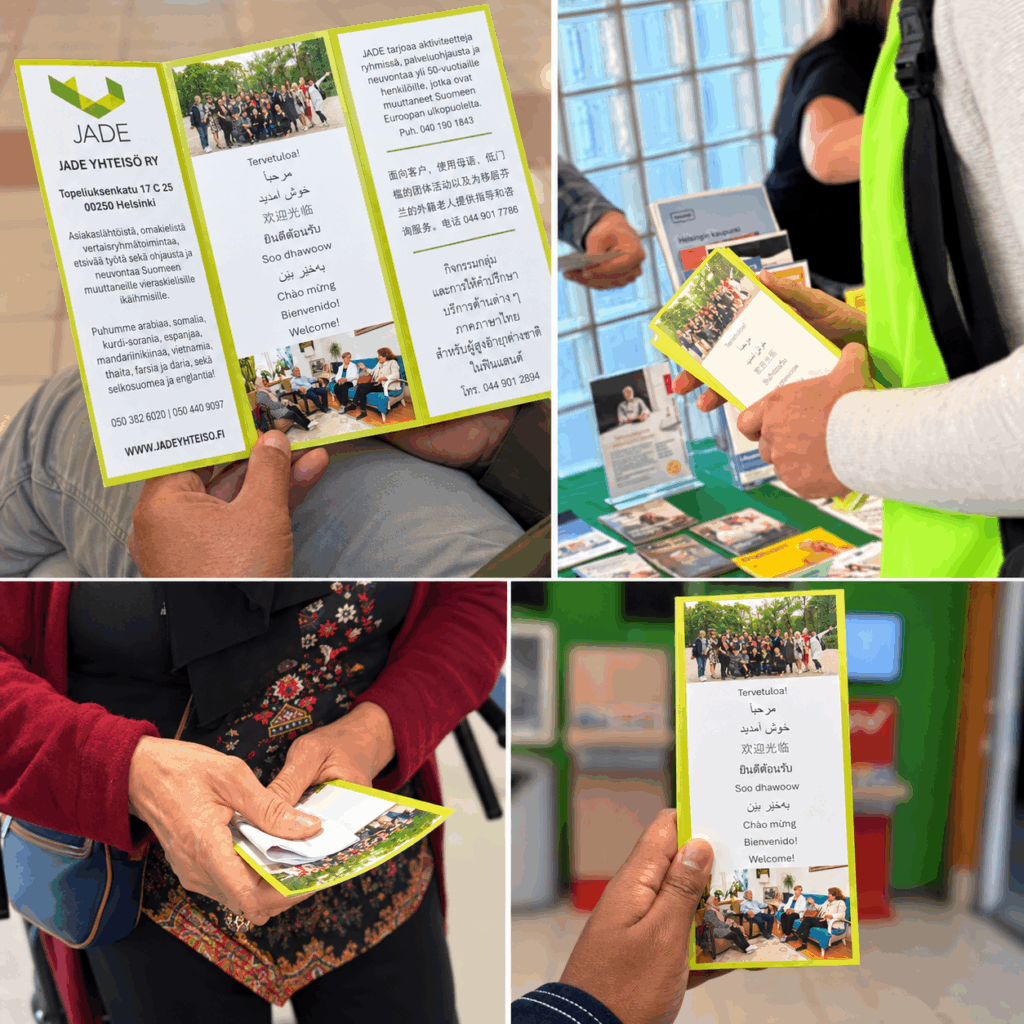
We sometimes imagine social isolation or exclusion from services as something that happens at particular moment such as someone stops attending activity or does not apply for support they need but in reality it may be the result of many small changes over a long period of time. Perhaps going outside has become more exhausting or scary or perhaps following the conversation in Finnish is more difficult than it used to be. It can also be that they tried to solve the issue, did not understand the instructions or didn’t find the correct place and feel reluctant to try again. Eventually the world outside one’s home may begin to feel unfamiliar even after decades living in the same place. This has made me think differently about ageing because we often discuss about integration as something that happens after migration but the connections, skills and social networks people build are not necessarily permanent even if you never migrated. They can weaken when circumstances change especially for older people. Research on identifying and recruiting older people at risk of loneliness and social isolation has examined the limitations for relying on a single method for outreach. We also advertise in social media and have brochures in multiple languages but information being available does not necessarily mean it reaches those who need it the most. For example to act on seeing a brochure, someone must first encounter it, understand it, recognise the activity as relevant to them and be able to take the next step. Each of these seemingly simply steps may involve barriers that are not immediately visible to the organisation providing the activity. This is one reason why we have noticed that to reach the ones who are not finding us, we have to move beyond our usual settings.
Reaching people through their everyday lives
During this year, we have gone into the everyday environments of older people with migrant backgrounds. We have developed local partnerships, worked with other organisations and public services, arranged encounters in people’s own languages, made home visits and provided short-term accompanied support. We have also explored how existing community relationships can help us reach people who might never respond to formal invitation. Sometimes a new connection comes through someone already attending a peer support group, sometimes it comes doing outreach work in the streets of the local neighbourhoods and sometimes even a neighbourhood butcher’s shop where older person regularly goes. These may seem like rather informal routes into outreach work but I have come to appreciate what they tell us about trust. People have their own everyday routines and networks of relationships, many of which are not visible in service directories. Someone who would not contact an unfamiliar organisation or service may be willing to have a conversation when the invitation comes through a person they already know such as the local store worker we had a chat with about our activities and left them brochures.
At the same time, these approaches has made us recognise its limitations. If we reach older people through communities and existing social relationships, are we mainly reaching those who still have some connection to other people? What about someone who no longer visit local shops, attends community activities or knows anyone involved in an organisation? What about someone whose mobility has deteriorated to the point that leaving home is no longer realistic?
Going into communities can help us reach people who remain invisible to formal services but it does not mean we reach everyone. In fact, one of the most interesting things about developing outreach work has been that every new way of reaching older people also makes us more aware of those who remain beyond its reach. This has made home visits and different forms of referral particularly important to consider. Yet even these raise questions. Who knows that a person is struggling at home? Who notices when someone disappears from everyday community life? And who has both the opportunity and the trust needed to introduce support without making the person feel that their independence or privacy is being threatened? There is also another distinction that has become increasingly important to us, reaching someone is not necessarily the same as establishing a meaningful connection.
One can meet someone, explain and give them information and then record the encounter as successful one. But what do one really know at that point? Perhaps they did not fully understand what was offered. Perhaps it did not seem relevant to them at that moment or they need several encounters before feeling comfortable enough to speak about their situation. Sometimes a first conversation may lead nowhere immediately but become meaningful months later. Someone may return when their circumstances change, tell a friend or remember there is somewhere they can ask for help. These are difficult outcomes to capture through the number of encounters alone. Sometimes when a person does return, we discover that the reason they first approached us was only a small part of what was really happening in their life.
What becomes visible after the first encounter?
One of the things that has made me think a lot lately regarding outreach work is how little we can sometimes understand about a person’s circumstances from the issue they initially bring to us. Someone may need help with banking, another person may have questions about a decision given to them and one may meet us visibly frustrated after trying unsuccessfully to get help from several different places. These are the problems that begin the conversation but they are not always the reason why the person needs the encounter.
Recently there was a conversation that began with considerable frustration and the older person raising their voice. At first, it was difficult to understand which of the many problems being described was the most urgent. As we continued talking calmly in the person’s own language, a much more complicated picture gradually started to emerge. There were experiences of war and displacement, losses within the family, ongoing worries about relatives living in unsafe circumstances, serious health problems and financial insecurity. Thee was also painful sense of no longer being able to support and protect loved ones in the way the person once had. By the end of our conversation, the older person apologised for the way they had spoken in the beginning and explained that the anger had not been directed at me. They were simply exhausted by everything that is happening. I have thought about that encounter many times since. The older person had not really changed during our conversation but what changed was my understanding of their situation. This also made me reflect on how we can interpret people’s choices and behaviour. If an older person with migrant background refuses recommended medical treatment, we may naturally wonder whether they understand its importance. But what if their decision is shaped by fear of hospital bills, unpaid expenses and the possibility of not having enough money left for rent? What if they are already living with severe pain, sleeping poorly and rationing food so they have enough until the next pension payment?
In such circumstances, what looks like an unwillingness to cooperate or accept treatment may be an attempt to survive situation in which meeting one essential need appears to threaten another. These experiences have also made me think about how gender and life history can shape people’s relationship with support. We cannot assumer that older men or women experience ageing in any single way. Nevertheless, the roles and expectations people have lived with for decades may remain deeply significant in later late. For someone who has understood their role as provider, protector, problem solver or head of the family can feel from their perspective that declining health and financial insecurity affects more than their practical independence. They can challenge that person’s understanding of who they are and what they can still offer to others. This may be particularly painful when family members continue to live in difficult circumstances and the sense of responsibility remains, even as the ability to help diminishes. In other situations, particularly among some older women we have encountered, the questions of independence and support have a very different history. A older woman may have married very young and spend much of her life in a relationship where her husband controlled finances, mobility, contact with others and decisions about everyday life. If that relationship involved violence or coercive control, its effects do not necessarily disappear when the relationship ends. I have thought about what later life means for someone who only then begins to experience the possibility of making decisions independently. She may need to learn to manage matters she was never allowed to handle, build new relationships and consider what she wants from her own future. Yet this opportunity may be at the same time when her health and physical capacity are beginning to decline.
It is very contradictory, person gaining independence at the same time as ageing creates new forms of dependence. It also raises an important question about how we understand older people’s capabilities. When someone is struggling with banking, digital services or independent decision making, are we seeing a skill they have lost or one they never had opportunity to develop? There difficulties may look similar from the outside but their histories are very different.
If someone has spent most of their life having decisions made for them, support should not mean another person takes over. In ideal situation support should create opportunities for that person to exercise the independence they may only recently have gained. Family relationships can make these situations even more complicated. An older person may have adult children or other relatives living nearby but this tells us very little about the quality of those relationships or the support actually available to them. Children who grew up in a household affected by violence may carry painful experiences into adulthood. A mother may have been a victim of violence herself while her children remember that she was unable to protect them. Both experiences can be real at the same time. We sometimes assume that the presence of family means support is available but having relatives is not the same as having safe, reliable or sufficient support. Sometimes the person providing most of the care is already struggling under the weight of that responsibility.
These questions matter because loneliness and isolation are not always about the absence of other people. Someone can feel profoundly alone within a family, surrounded by relationships shaped by unresolved experiences, obligations and disappointments. Someone else may have people around them but no one with whom they can speak openly. The more we encounter these different experiences, the less useful it seems to think of loneliness being measured by how often someone meets others or attends activities.
Back known to services, yet remaining unseen
Another important discovery has been that the people we encounter through outreach are not necessarily outside the service system. Someone may already receive several benefits, have contact with different professionals and have undergone a formal assessment of their needs. They may have spent months trying to resolve a particular problem, yet something essential in their everyday life remains unresolved. We have encountered situations where an older caregiver has repeatedly tried to manage banking matters for a dependent relative, only to find that access to the account is blocked and they lack legal authority required to resolve the issue. Money may exist in the account but remain inaccessible, while the whole family household finances become increasingly difficult. The bank deals with the banking rights, Digital and Population Data Services Agency (DVV) with the guardianship matters, third organisation with the pension and other benefits and the fourth with social services. Each has its own responsibilities and legal limitations. For the older person living through the situation however these are not separate issues. They are one problem that has gradually spread into every part of daily life.
We have experienced throughout the years in our service guidance and also in outreach work how often older people with migrant backgrounds do not fully recognise the services or benefits they already receive. Someone may know that a payment arrives regularly but do not understand what it is called or which organisation provides it. They may remember a professional visiting their home without connecting that visit to a formal service assessment. A person receiving caregivers allowance may not even identify themselves as a recognised caregiver. If we just ask this person whether they receive particular benefit or has had particular assessment, the answer may therefore be inaccurate, even when the person is trying to answer as carefully as possible.
This has made us notice what we mean when we say that someone has been given information or guidance. If older person has been told to contact a certain service provider, make a bank appointment or arrange authorization to act on behalf of a relative, has their need for support been met? Sometimes of course it has but what if they do not understand where to begin, what documents are required or why they must approach another organisation to begin with? What if they follow the instructions as best they can, only to find themselves back where they started?
One unresolved problem can begin to generate many others. Banking difficulties affect income, financial insecurity increases dependence on relatives or public services and the person eventually needs help with an expanding range of issues. They may have to explain their circumstances repeatedly to professionals who each see only the part that falls within their responsibilities. I don’t think this should automatically be understood as a failure on the part of individual professionals. Many are working within systems that have clearly defined responsibilities, limited resources and certain legal frames they have to abide. But from the older persons perspective, the result can be that they are expected to coordinate a complicated network of services themselves. This requires a surprising number of skills that we may not always recognise we are expecting older people to have. They need to identify their needs, know which organisation is responsible, describe their circumstances using the appropriate terminology, understand instructions, remember what has been agreed and follow u when things do not progress. These demands can be difficult for anyone but they become considerably more demanding when someone is living with illness, limited language or literacy skills, financial insecurity, unfamiliar digital systems or the effects of difficult life experiences. Interpretation can be essential in building understanding but translating information does not necessarily make the underlying system easier to navigate.
This is one of the areas where community based outreach work can offer something important. We can’t replace statutory services, make decisions on their behalf or solve every problem that are brought to us but we can sometimes take time to look at a situation as a whole rather than only through the responsibilities of one organisation. We can help someone understand which services they already receive, what remains unresolved and what the next steps might be. Sometimes accompanied support even for a single appointment can make the difference between receiving another set of instructions and actually being able to act on them. At the same time, these experiences have made us more aware of the limits of what outreach work itself can achieve. We can identify a problem, help a person communicate it and support them finding the right service but what happens when the service they need is unavailable, difficult to access or unable to respond to the complexity of their situation? That is not a question outreach work can answer on its own.
What happens after we find someone?
When we began developing our outreach work, much of our attention was naturally focused on finding new ways to reach older people with migrant backgrounds. How could we make ourselves visible outside our usual activities? Which local partnerships might help? Where could we meet older people who were not already involved in any activities? These are important questions but I have increasingly come to think that the more difficult question begins after the first contact has been made, then what happens?
Did the older person become connected to a service they genuinely needed and did they find an activity, a community or another person who became part of their everyday life? Were they able to resolve something that had been troubling them for a long time? Or was it just a one successful encounter after which they remained as disconnected as before? This is very important thought to keep during the whole process when encountering older people with migrant backgrounds. One can count encounters, home visits, events, referrals etc., these figures of course tell us something about the scale of the work and the activities that have been undertaken but they also tell us much less about what has actually changed in people’s lives.
We have become particularly interested in what happens between the first encounter and a more lasting connection. Sometimes that connection is our peer group or a local activity by another community or organisation. Maybe it is social or healthcare service that the older person had not previously been able to access or them just knowing that there is now one familiar place to return to when another problem arises or they have the strength and personal resources to join activities. I do not think every encounter needs to lead to participation in an activity or to an outcome defined in advance by an organisation. People have the right not to participate and what matters most to them may have very little to do with joining something. Someone may first need financial security, support in a difficult family situation or help to regain confidence in managing everyday matters. If one measures success only by how many people join our activities, we risk evaluating how effectively people adapt to what is offered rather than how well the work responds to what they actually need.
During this year I have deepened my understanding on someone being invisible. I have begun to realise how much can remain invisible even when someone is sitting directly in front of us. We may know their age, language skills, family circumstances and services they receive but not what they have lived through, what they are afraid of or what they are trying to protect by not speaking. Sometimes a person needs help they do not know how to ask for and sometimes they have already asked many times without finding a way forward.. Sometimes they have gradually stopped asking altogether. To us in JADE outreach work is not only discovering where people are and finding ways to make contact, it is also about recognising what we have not been seeing, including in the lives of people who are already known to us. It is important to keep asking besides how do we find someone but also what happens after we have found one another.
Nashwa Khatiri
Diversity Work Developer
Jade Community
Association for Older People with Migrant Background
www.jadeyhteiso.fi
